
Well, Formula 1’s “silly season” is definitely underway. Sebastian Vettel’s retirement has set off a wild chain reaction that has culminated in something that has been debated and rumored the whole year: Daniel Ricciardo’s contract will be bought out for 2023, ending his time at McLaren.
If you’ve seen my tweets this season it shouldn’t be too much of a surprise that I was happy with this move. I’ve felt Ricciardo has been a detriment to McLaren so far and I’m a fan of the team first, so I was looking forward to bringing in the hotly anticipated Oscar Piastri. Of course, I have nothing against Ricciardo the person: he’s immensely charismatic and has a terrific smile that is visible from Australia. My issues were with Ricciardo the driver, and I felt McLaren would be better off with someone else out on track.
But as he’s now on his way out, I’ve seen an overwhelming wave of support going his way on social media, and I’ve began to doubt my stance. Was he really all that bad? After all, he does have McLaren’s only race win in the last ten years – that counts for a lot. And so I went back and took a look at Ricciardo’s results at McLaren to see if sending him out the door really was the right move.
Prologue: Great Expectations
In the build up to the 2021 season, spirits were high among McLaren and Ricciardo fans alike. While his two seasons at Renault hadn’t been spectacular, neither was the car he was given. His reputation from his success at Red Bull was still quite intact, and McLaren was a team on the rise: they had just finished third in the championship, were boasting the up-and-coming Lando Norris as their other driver, and were bringing in a new, best-in-class, Mercedes-built power unit.
The consensus around Ricciardo from fans and media was that he would at least be on par with if not better than Norris, who was entering just his third year in F1. It made sense – Ricciardo had won several races at Red Bull and was entering his 10th full year in Formula 1, giving him a significant leg up in terms of experience. Sure, Norris had more familiarity with McLaren, but Ricciardo was a highly respected driver amongst fans, media, and the paddock.
And he was certainly paid like it: Ricciardo signed a 3-year deal worth $15 million a year, tied for 4th most expensive in 2021 with Sebastian Vettel and only behind the likes of Lewis Hamilton, Max Verstappen, and Fernando Alonso. Yes, it was a lot, but it seemed worth it given Ricciardo’s caliber and experience.
Chapter 1: A Rough Start
The 2021 Formula 1 season saw several drivers moving to new teams and having difficulty adjusting and performing at their expected level. Sebastian Vettel at Aston Martin, Carlos Sainz at Ferrari, and Sergio Perez at Red Bull all struggled in their new environments at the start of the year. Ricciardo was no exception, failing to match the results of teammate Lando Norris for the first half of 2021.

Of course, it didn’t help Ricciardo’s case that Norris was on an incredible run of form for the start of the season. Norris finished in the top 5 in 9 of the first 10 grand prix and nabbed 3 podiums in the process. The lone outlier was still a points finish with an 8th place in Spain. Norris also reached Q3 in every chance he got, not just in the first half of the year, but the entire season bar Belgium (where he crashed out in a very wet Q2 while in the conversation for a front-row start).
Ricciardo, on the other hand, struggled in qualifying, going out in Q1 once and Q2 five times out of the first 11 races. However, while he was certainly lacking for one-lap pace, his race pace seemed in a slightly better spot. Over the same stretch, Ricciardo would only lose positions from the start to the end of the race on one occasion, the season opener in Bahrain, and there he only dropped back one place to still finish in the points in 7th.
But in head-to-head finishes, Ricciardo was demolished. In the 10 races where both McLaren drivers finished, Ricciardo only finished ahead of Norris once, taking 6th to Norris’ 8th in Spain. Barring his lone DNF in Hungary, Norris finished in the points every time. Meanwhile, Ricciardo missed out on points on three occasions (Monaco, Styria, and Hungary). Interestingly enough, on those three occasions, Ricciardo finished where he started – 12th, 13th, and 11th respectively. So while he wasn’t losing places, he at times struggled to make them back up after qualifying poorly. Comparatively, Norris gained places in every race he finished besides Austria, where he dropped a single place to still finish on the podium in P3.
It’s impossible to argue Ricciardo was living up to expectations prior to the 2021 summer break. He was thoroughly getting trounced by Norris, who was trying to prove himself against an established driver and was undoubtedly succeeding. But, as I mentioned before, Ricciardo was hardly the only driver struggling on a new team in comparison to his teammate. Not only that, but he had a tall task in adapting to what has been described as a unique and difficult car to drive, especially compared to what Ricciardo reportedly likes. So, while it certainly was not a great look, it was too early to write off Ricciardo just yet.
Chapter 2: False Dawns
A common refrain arose during the first half of the year which followed Ricciardo and McLaren through the summer break: “When will Daniel Ricciardo turn the corner?” Obviously, they weren’t referring to corners on track, although you could certainly argue that was something he needed to do better. The question refers to his return to form – when would he get to grips with his new team and car and demonstrate the pace and experience he’d shown in the past?
There could be no better statement of “I’m back” than a win. And that’s exactly what Ricciardo got. After the glorified farce of a boat parade in Belgium and a rough weekend at Zandvoort, McLaren tasted the sweet foot-sweat-infused champagne of victory in Monza, taking a 1-2 finish with Ricciardo on the top step. It was the first time McLaren had won a race since 2012, and many hoped it was the sign they had been looking for – that the Ricciardo they knew might be on his way back.
McLaren rode the wave of success into Russia, with Norris taking pole position and leading most of the race, and Ricciardo wasn’t too far behind after qualifying P5. But a late burst of rain threw the entire race into chaos, and an inexperienced Norris stayed out one lap too long. After getting passed by several drivers who had stopped earlier to change to intermediate tires, Norris ended up finishing down in P7. For the second race in a row, Ricciardo bested Norris as he ended up taking P4. Was Ricciardo back? Had he returned to form?
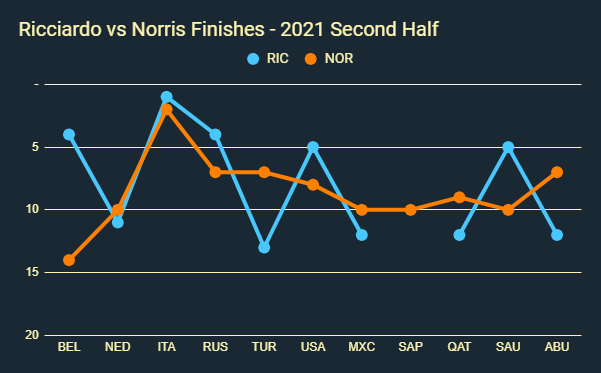
Unfortunately, these two races would be the highlights of Ricciardo’s season and were merely a deviation from a pattern that plagued him throughout all of 2021: Ricciardo was consistently inconsistent. One race he’d finish in the middle of the points, the next he’d finish in the low teens, multiple places out of even a single point. While his high points did help him eclipse Norris on more occasions in the second half of 2021, his low points were still lower, as Norris never failed to score points the rest of 2021, while Ricciardo missed out on points 4 times.
Ricciardo managed to improve his qualifying results in the second half of the year, as he only went out in Q2 twice in addition to another Q1 elimination. However, the only pre-Q3 elimination Norris saw in all of 2021 was the previously mentioned Belgium, helping him to a 15-7 qualifying advantage. The average qualifying gap between the two was 0.536 seconds from Norris to Ricciardo. For context, here’s the list of driver pairings with a smaller gap in 2021:
| Faster Driver | Slower Driver | Average Gap (s) |
|---|---|---|
| Antonio Giovinazzi | Kimi Raikkonen | 0.273 |
| Lewis Hamilton | Valtteri Bottas | 0.347 |
| Esteban Ocon | Fernando Alonso | 0.369 |
| George Russell | Nicholas Latifi | 0.371 |
| Max Verstappen | Sergio Perez | 0.528 |
There are some pretty shocking pairings on this list given how maligned Bottas, Perez, and Latifi were for their qualifying pace compared to their teammates. For reference, those three drivers were a combined 57-8 against their teammates in head-to-head qualifying. For Ricciardo to be further off the pace of his teammate on average than those drivers is far from ideal.
Overall, Ricciardo only placed ahead of Norris 6 times in 2021 when both drivers finished (5 if you don’t count Spa). However, the points total was 160 for Norris versus 115 for Ricciardo, which certainly looks much closer for Ricciardo than many other metrics mentioned so far. And ultimately, it is the points that matter. So while Ricciardo had yet to find consistency in the car, he did regularly show flashes of potential. The issue was they were all quickly followed by disappointment. Perhaps the offseason and a brand-new car would be the lift he needed to find consistency.
Chapter 3: The Wrong Consistency

As the chapter title alludes to, Ricciardo has found more consistency in 2022. The issue is, the consistency he has found has been in finishing out of the points entirely. Out of 12 race finishes, only 4 have ended in points. By comparison, Norris has finished in 7th place 4 different times, and in the top 6 an additional 4 times. Out of the three times Ricciardo has finished ahead of Norris, twice it was by only a single place, and the other was in Canada, where Norris suffered power unit issues late into the weekend and went into the race significantly down on power as he was using a much older unit.
The Q3 run Norris was on has ended, as he’s only reached it on 7 of 13 occasions, settling for Q2 the remaining 6. Ricciardo’s numbers are as a result more comparable at 5 Q3 appearances and 6 Q2 eliminations, but still has 2 Q1 eliminations hanging over his head. Additionally, the head-to-head results are on pace to be even worse, with Norris leading 11-2. All in all, the difference in performance this year can be clearly seen in the points totals: 76 for Norris and just 19 for Ricciardo. If anything, Norris might actually be in better form in 2022 than he was during the second half of 2021, while Ricciardo appears to be worse. There are opinions floating around that McLaren is the source of the problems, as after a strong test in Spain the new car seemed to completely fall apart in Bahrain. And while the overall pace of this year’s car appears to be worse compared to the rest of the field, Norris’ regular scoring makes it difficult to say Ricciardo’s struggles are due to any circumstances affecting both drivers.
Chapter 4: Replacement

Based on the results for not just 2022, but 2021 as well, it is pretty apparent Ricciardo is the second-best driver at McLaren. Cumulatively, Norris has finished ahead in 22 of the 31 races where both drivers finished. When he has finished, Norris has also only missed out on points 3 times since the start of 2021, and one of those times was at (unsurprisingly) Spa. By comparison, Ricciardo has finished out of the points 16 times in the same span, with 8 of those times coming in just the first half of 2022. On average, Norris qualifies in 8th place (8.23), while Ricciardo is back in 12th (11.77). Their average finishes are again in Norris’ favor, with 8th for Norris (7.55) and 10th for Ricciardo (10.03).
In races where Norris finishes ahead, he beats Ricciardo by an average of 4.55 places, whereas Ricciardo only finishes ahead by an average of 3.33, or 2.50 without Belgium. To give that a bit more meaning, let’s put those numbers in the context of their average finishes. Let’s say Norris finishes ahead and gets his average of 8th place. This means we would expect Ricciardo to finish around 12th or 13th, out of the points by multiple positions. By comparison, if Ricciardo finished in 8th (2 full places higher than his average finish), we could still expect Norris to potentially nab a point, as he would on average finish in 10th or 11th place. To summarize, when Norris finished better (which he usually did), Ricciardo would be significantly behind, while when Ricciardo finished better, Norris could still bring home a decent finish.
Having a clear first and second driver isn’t inherently a bad thing – many teams have won constructors and/or drivers championships thanks to this formula, as it provides a clear hierarchy for the team to strategize around. As long as the second driver accepts their role in playing the team game, it can be extremely effective as a result. Unfortunately, McLaren is not currently competing for championships. They would be better off having two equally strong drivers or two young drivers who will be ready to compete for championships in a couple of years when the team hopes to be in the hunt. Ricciardo is not at McLaren to play second fiddle. He was brought in to be an equal if not superior driver to Norris and so far has failed to live up to that billing, despite being paid what is now tied for the 5th largest contract in F1. It’s not entirely about the money, but Ricciardo is currently making more than 14 other drivers on the grid, and it’s hard to say he’s been better than all 14 during his time at McLaren.
With all that in mind, when the opportunity arose for McLaren to sign the 2019 Formula Renault, 2020 Formula 3, and 2021 Formula 2 champion Oscar Piastri, it made too much sense for them not to. While he isn’t racing in 2022, he is still a reserve driver for Alpine (currently McLaren’s rival in the 2022 championship) which has kept him in the Formula 1 ecosystem at a decent enough level. Sure, he will likely struggle compared to Norris in 2023 and many may use that as evidence that McLaren were wrong to oust Ricciardo, but it’s really all a matter of expectations and upside. Piastri will and should have lower expectations as a rookie who hasn’t raced in a year. It’s understandable and even expected for a new driver to struggle as they adapt to the top level of motorsport, and McLaren isn’t concerned about 2023 with this move. The expectation for Piastri is that he will improve and make good on the promises of talent he’s shown as he’s dominated the junior ranks. Ricciardo has not shown any signs of improvement in the last year and a half and is 33 – growing pains are not an acceptable part of the equation for a driver like him anymore. Given his experience, time with the team, and potentially even development focused on gearing the car more to his style, he should have at least reached the level of his teammate by now. Instead, he has failed to match the expectations for him, and buying out his last year in order to sign Piastri is the right decision for McLaren’s future.
Epilogue: Well Wishes
I want to make it clear that I do not think Ricciardo is a bad driver. His time at Red Bull, podium at Renault, and win at Monza are clear indicators that he is anything but. Instead, I think he’s been bad at McLaren, and that may not even be entirely his fault. It may just be a very poor fit. His poor performance is at least partially his fault, since he’s the one driving the car, but there are many other elements that make up a Formula 1 team, and the way things work at McLaren may just not work for Ricciardo. Supposedly, Ricciardo has already been contacted by several teams about joining them for 2023, and I hope he does end up on a decent team for next season, one that fits him better and helps bring that ginormous, blazing smile back to the paddock. In that way, maybe leaving McLaren after this season is the right move for him too.
Thanks to Formula 1 for race results and 2022 starting positions, GP Racing Stats for 2021 and 2022 qualifying results, RaceFans for 2021 starting positions and average qualifying gap, and RacingNews365 and Motorsport Tickets for driver salaries.
 Opposite Field Sports